Mulching: What It Changes in Soil—and Where It Quietly Fails
Mulching changes the top few centimetres of a bed before it changes the soil underneath. A well-chosen layer reduces evaporation, softens rain impact, slows crusting and moderates temperature; it does not instantly turn compacted or waterlogged soil into good soil. The quiet failures begin when the material is too fine, too deep, kept wet against stems, or used to cover a drainage problem.
The practical rule is simple: choose mulch for the job, then judge it by what happens at the soil surface and in the root zone separately. A surface layer can be doing an excellent job of conserving water while the plants below it are staying too wet.
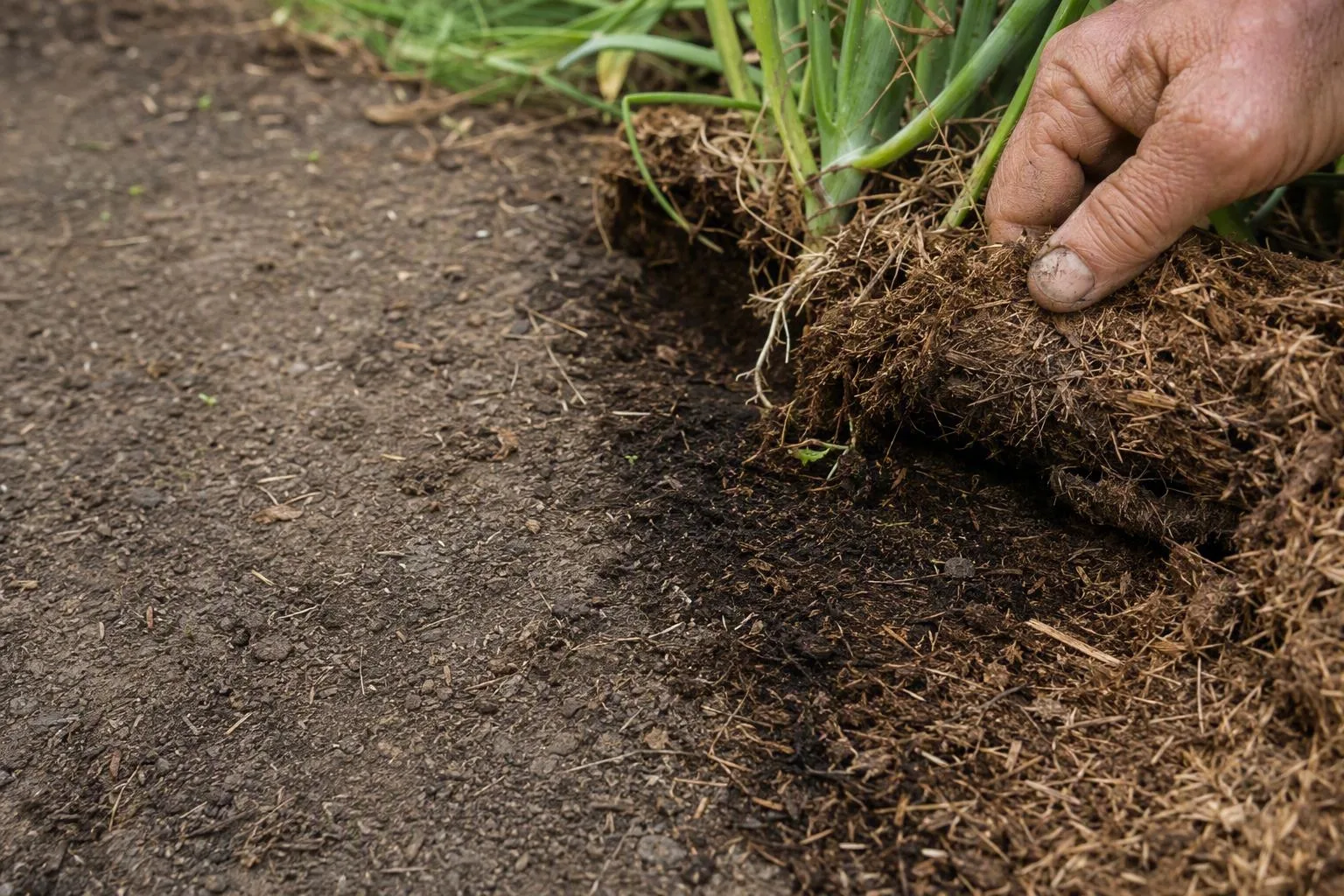
The short answer: mulch changes the soil surface first, then the soil beneath it
Mulch is a layer placed over soil rather than mixed through it. That boundary matters. The material intercepts sun, wind and raindrops at the surface, so the first benefits appear within days or weeks: less exposed soil, slower moisture loss, fewer hard crusts after heavy rain, and less soil splashed onto foliage.
Organic mulch brings a second phase, but only after decomposition begins. Fungi, bacteria and soil animals gradually break down leaves, straw, bark or chipped wood. Some of the resulting carbon compounds enter the surface soil; much of the original volume disappears as carbon is respired. A thick layer of wood chip is therefore not a compost heap sitting neatly on the bed. Most of it remains above the root zone while it is doing its first job as a physical cover.
That distinction prevents two common mistakes. Adding more mulch will not fix a compacted pan or a raised bed with a blocked base. Nor does mulch automatically improve every soil: in a cold spring it can delay warming, while in a wet bed it can preserve the excess moisture that is already stressing roots.
- Use mulch for the surface: evaporation control, splash reduction, erosion protection and weed suppression.
- Use compost and structural cultivation for the soil profile: organic matter incorporated at the appropriate time can change pore space more directly.
- Watch the boundary: stems, crowns and the upper root zone should not remain continuously wet simply because the mulch looks tidy.
Follow one layer of wood chip mulch through its first three seasons
Picture a 5 cm layer of mixed, reasonably dry wood chips spread around established berry bushes in early summer. The chips touch one another, but they still leave air spaces. The soil below is moist rather than saturated.
Season one: cover before conversion
During the first weeks, the main change is physical. Rain lands on chips instead of striking bare soil. Wind has less access to the soil surface, and the shaded boundary loses water more slowly. Fine fungal threads may appear between chips after wet weather. That is decomposition beginning at the most exposed, moist contact points, not proof that the entire layer has become rich humus.
After repeated rain, the layer settles. In an illustrative example, a 6 cm starting layer might settle to roughly 4–5 cm. That is a useful planning range, not a measured constant: chip size, rainfall, settling, temperature and climate all change the result. Fine chips can compact sharply; coarse chips may barely change height while still shifting sideways.
Season two: a more connected surface
By the second growing season, the lower chips are darker and softer than the fresh material above them. Leaf fragments and dust have collected in the spaces. Earthworms and other soil organisms may work at this interface where moisture and organic food coincide. The surface can hold together more than it did at application, especially if the material was fine.
That does not mean the whole layer has moved into the root zone. A trowel pushed through the mulch may still meet a distinct line between darkening chips and the original soil. The visible improvement is often greatest at the surface: less crusting, a softer top layer and more stable moisture. Deeper compaction remains a separate problem.
Season three: collapse and replenishment
Some of the smaller pieces are now unrecognisable, while the coarser pieces remain. The layer has lost volume and may no longer suppress weeds evenly. At this point, topping up can restore the surface function, but piling fresh chips over a damp, matted layer can create a new problem.
Rake aside a small patch before replenishing. If the old mulch is friable and smells earthy, a modest top-up is reasonable. If it is slick, sour-smelling or packed into a continuous sheet, loosen or remove the failing section first. The aim is an open, air-permeable cover, not a permanent stack of increasingly wet organic material.
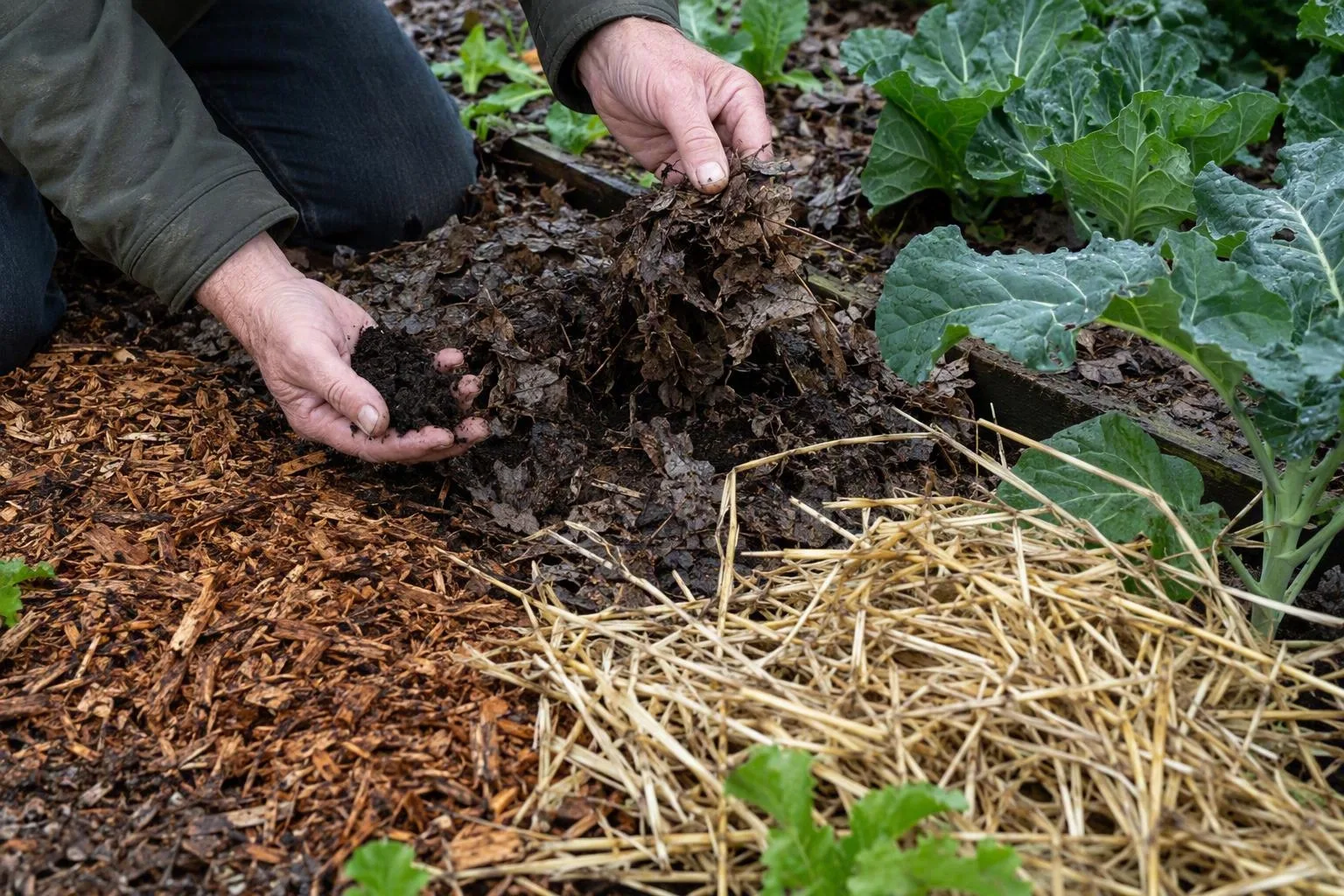
Water, temperature, and structure: the changes you can measure before the mulch rots
The quickest test is not visual. After similar weather, push a finger or narrow trowel through the mulch and compare the covered soil with an uncovered patch. The covered patch should usually lose moisture more slowly because the mulch interrupts direct evaporation and reduces wind movement at the soil surface. That is useful in a sandy bed or beside thirsty crops. It is not automatically useful in a bed that is already slow to drain.
Mulch also changes how rain arrives. A bare surface receives raindrop impact directly, which can dislodge fine particles and close surface pores. A coarse organic layer breaks that impact before water reaches the soil. If the soil beneath is reasonably open, this can reduce crusting and help infiltration. If the underlying layer is compacted or waterlogged, the same cover may simply keep the surface damp for longer while water struggles to move down.
Temperature is a seasonal trade-off. A shaded soil surface heats more slowly in spring, particularly under a thick or wet layer. That can be a disadvantage for direct-sown beans, squash or warm-season transplants waiting for the root zone to warm. In hot weather, the same shading reduces sharp surface heating and protects shallow roots from rapid swings.
For raised beds, this is part of the irrigation calculation. A mulched bed may need less frequent watering in dry weather, but it can also show wet soil for longer after irrigation. The relevant question is not “Does mulch retain water?” It is “Does this bed need water retained at this depth, under this crop, with this drainage?” For the related trade-off, see Raised Beds and Water Use: How Bed Design Changes Irrigation.
The nitrogen tie-up problem is real—but usually happens at the wrong boundary
Microbes need nitrogen as well as carbon to build their cells while decomposing high-carbon materials such as fresh wood. If those materials are mixed into the soil, the decomposers and crop roots share the same zone. Microbial demand can temporarily reduce the amount of readily available nitrogen around young roots. That is the classic nitrogen tie-up problem.
A settled layer on the soil surface is a different arrangement. Most of the decomposing material is above the main root zone, and the active microbial boundary is concentrated near the surface. Some nitrogen movement still occurs, especially where fine material is incorporated by cultivation or earthworms, but the risk is not equivalent to digging a thick layer of fresh chips into a bed before sowing.
Look for a genuine shortage rather than fertilising by reflex. Plants may show pale older leaves first, reduced growth and thin new stems, but those signs overlap with cold roots, waterlogging and root damage. A simple check is to compare mulched and unmulched plants of the same crop under similar conditions. If only the bed where fresh woody material was mixed into the soil is pale, nitrogen competition becomes a stronger suspect.
The sensible correction is targeted: stop adding fresh woody material to the root zone, provide a suitable nitrogen source if the crop and soil assessment justify it, and allow time for the microbial flush to settle. Routine high-nitrogen feeding under every wood mulch is poor practice. It can push leafy growth, waste nutrients and disguise a drainage or root problem. For the chemistry and timing of compost additions, see How to Use Compost Without Creating a Nitrogen Tie-Up.
Choose mulch by the job: a side-by-side comparison of four common materials
“Best mulch” is an incomplete question. The right material depends on whether the priority is a clean vegetable row, a shrub border, a path edge or rapid moisture control.
| Material | Useful role | Where it struggles |
|---|---|---|
| Screened wood chips | Longer-lasting cover around established shrubs, fruit bushes and paths | Can delay spring warming; fine material can mat; poor choice mixed into seed rows |
| Shredded leaves or leaf mould | Flexible surface cover that breaks down into a softer, darker layer | Whole leaves can form a slick mat; wind can move a thin layer |
| Straw | Light seasonal cover for paths and some vegetable beds | Can contain seed, blow around and shelter pests when persistently damp |
| Finished compost | Thin fertility and organic-matter dressing near actively growing crops | Expensive or wasteful as a thick weed barrier; fine texture can crust or settle |
Screened chips suit established plantings because their persistence reduces repeated disturbance around perennial roots. Shredded leaves suit areas away from crowns and can be useful where a softer material is wanted. Straw is practical when a light, temporary layer matters more than a polished appearance. Finished compost works best as a thin dressing rather than a thick weed-suppressing blanket.
For vegetable beds, the decision changes with the crop. A coarse, open layer can sit beside established tomatoes or brassicas once the soil is warm. A fine layer placed against tiny seedlings can obstruct emergence and stay wet around the stem. Wood chips are also a poor choice where frequent shallow sowing is planned; they shift under a dibber, trap labels and make a clean seedbed difficult to maintain. The comparison in Wood Chips in Vegetable Beds: When They Help and When They Get in the Way is the useful next step if that is your situation.
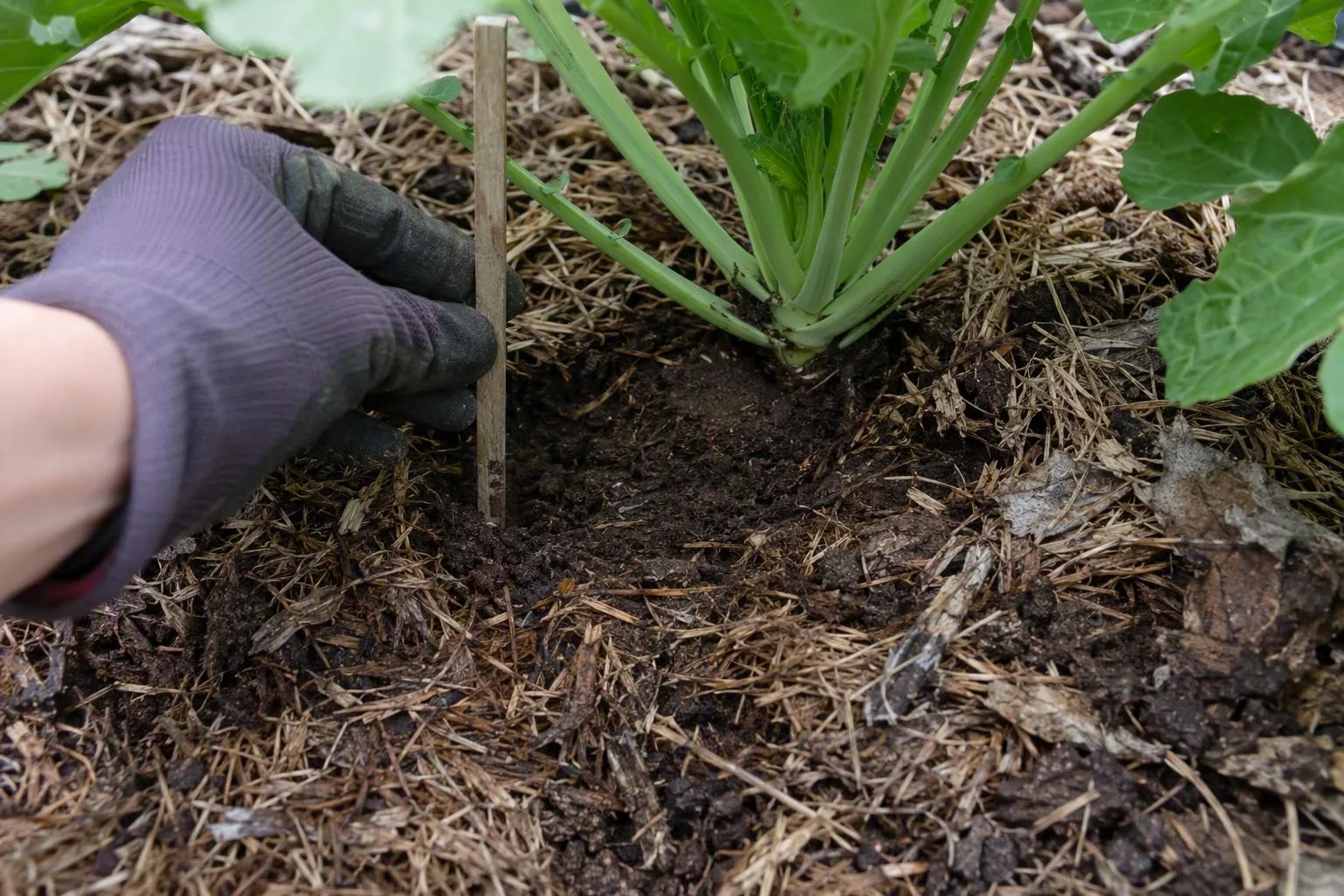
Application is a geometry problem: depth, timing, and the bare ring around stems
Mulch succeeds or fails partly by its shape. Start by clearing perennial weeds rather than burying their crowns under a fresh layer. Water dry soil before application if the bed needs it; mulch slows later water loss but is not a substitute for wetting a severely dry root zone.
- Spread the material evenly over the target area.
- Leave a visible gap around soft stems, crowns and tree trunks.
- Check the depth in several places, including the bed edge where material often thins.
- After heavy rain, rake aside a patch and inspect the surface beneath.
A practical starting point is a moderate layer rather than a dramatic mound. Use a thinner application in cool spring soil, particularly where seeds or small transplants must establish. A somewhat deeper, open layer can make sense in summer when evaporation is the main loss. The exact depth depends on material texture: fluffy straw occupies more space than settled leaf mould, and fine chips provide less air space than coarse chips.
Never pile mulch against a trunk or soft stem. The contact area stays damp, the bark or stem base gets less air, and inspection becomes difficult. A bare ring also makes it easier to see whether irrigation is reaching the root zone and whether pests are sheltering at the plant base.
Replenish according to the layer's remaining function, not a calendar. If the surface is still open, weed-suppressing and moisture-buffering, leave it alone. If it has collapsed into a thin, patchy cover, add enough to restore evenness. Continually piling new material onto the same wet base is how a useful mulch becomes a matted one.
When the layer fails: diagnose mats, slugs, sour smells, and persistent weeds
Mulch failure is usually visible before it is severe. The correction should match the physical problem rather than defaulting to complete removal.
A slick or water-repellent mat
Fine leaves, grass clippings or shredded material can knit into a dense sheet. Water beads on top or runs sideways, while the soil beneath may be dry in pockets. Break the surface with a rake, reduce the depth and mix in a coarser, airier material. If the mat reforms after every rain, the material is too fine for that location or is being applied too thickly.
A sour smell and grey, slimy lower layer
A sour or fermented smell, combined with a greasy lower layer, indicates poor air exchange in persistently wet organic matter. Do not add more mulch. Pull the failing material back from stems, rake it thin to dry where appropriate, and check the bed's drainage. If the soil itself remains saturated, see Diagnosing Waterlogged Garden Soil Before You Add More Organic Matter. Mulch can expose a drainage issue by keeping the surface wet, but it did not necessarily create the compacted layer below.
Slugs sheltering beneath the cover
Cool, damp mulch can provide daytime hiding places for slugs, especially in wet climates and around dense vegetation. That does not make mulch the sole cause. Check beneath boards, dense foliage and nearby debris as well. Reduce excessive depth, open the plant spacing where possible and water in a way that does not leave the surface continuously wet. Monitor at dusk before deciding whether the mulch itself is the main factor.
Weeds rooting through the mulch
Thin mulch suppresses some germinating weeds but is not a barrier against established perennial roots. Weeds can also germinate in dust and decomposed material collected above the original soil. Pull them while small, remove perennial crowns and restore an even layer. If the bed is repeatedly disturbed by shallow cultivation, a different material or a dedicated path surface may work better than simply adding depth.
The mulch disappears after rain
Fine leaves and straw can move downhill, wash into paths or blow from exposed beds. Use a coarser fraction, reduce the exposed edge, or apply after the soil has been watered and the material has had time to settle. A disappearing layer is a placement problem, not evidence that a thicker blanket is automatically the answer.
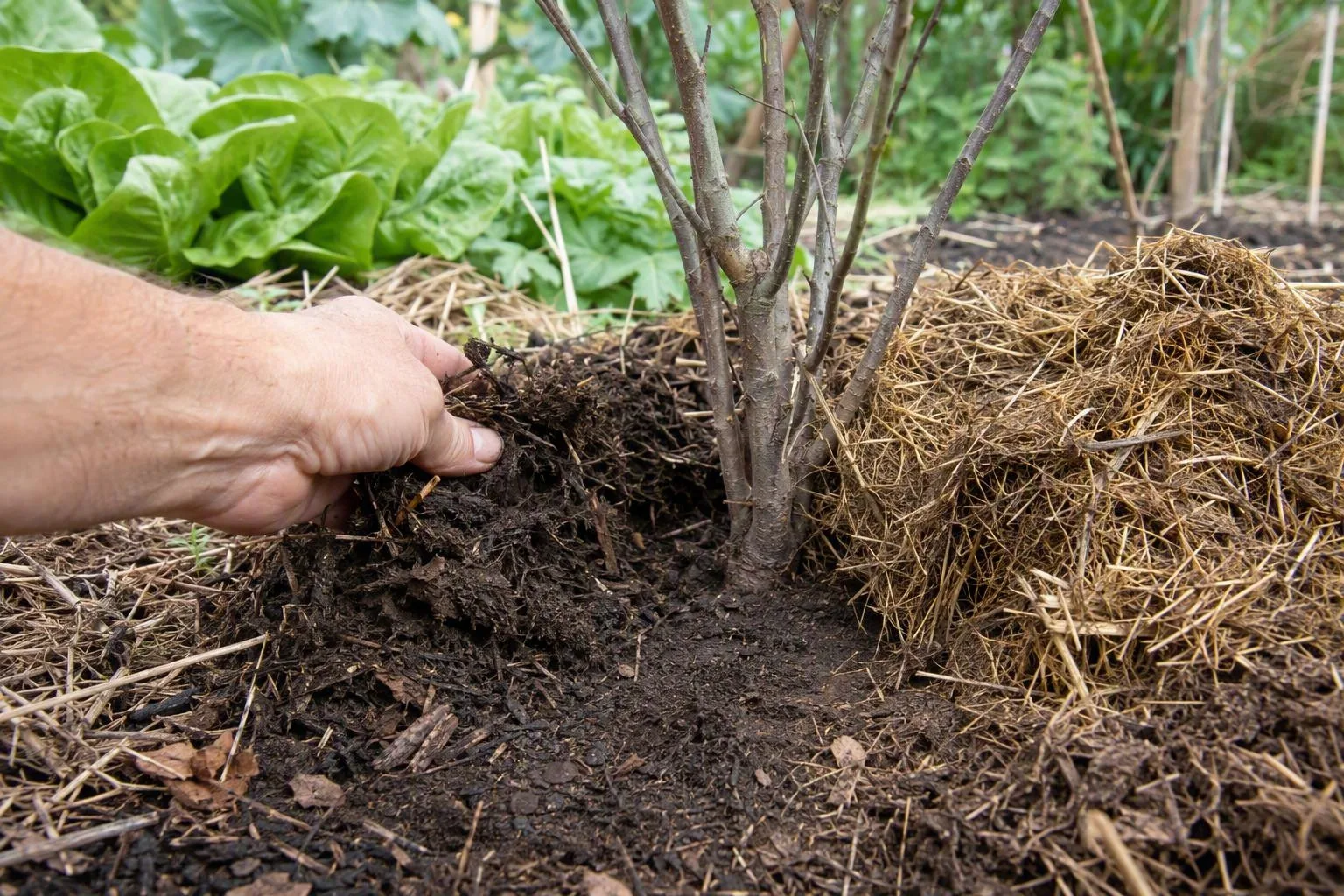
Judge the result after one season—and decide what deserves another two
Give mulch a small trial rather than treating the whole garden as one experiment. Leave a comparable uncovered strip beside a mulched strip, using the same crop and irrigation. After similar weather, check moisture at the same depth. Look at the soil surface after rain: has it crusted, stayed open or remained slick? Record weed pressure and inspect beneath the mulch for roots, worms, mats and bare dry pockets.
Some changes should be visible within weeks: less splash, slower surface drying and fewer rain-made crusts. Temperature effects appear during the next cool or hot spell. Changes in surface organic matter and friability may take a season or more, depending on material, climate and how much soil disturbance occurs.
Judge plant performance carefully. A plant that stays greener under mulch may be benefiting from steadier moisture, or it may simply be sitting in wetter soil. Check the root zone before calling that success. Healthy roots should not be assessed from leaf colour alone.
Changing one variable at a time keeps the result diagnosable. If the mulch, irrigation schedule, fertiliser and bed shape all change together, a better harvest tells you very little about which decision worked. Test depth first, then material, then watering if the problem persists.
The surprising part of mulching is that its strongest early effect is not “feeding the soil.” It is controlling the boundary between air, rain and soil. Once that boundary is working, decomposition can contribute to the surface system. If the boundary is staying saturated, adding more organic matter only gives the same problem a larger cover.
Questions that decide whether a mulch belongs in this bed
Does mulch make soil acidic?
Most common surface mulches should not be used as a substitute for a soil test or as a reliable way to acidify established garden soil. The immediate surface can change as organic material decomposes, but the direction and size of any pH shift depend on the material, soil and moisture conditions. Choose a mulch for its physical job first.
Should landscape fabric go under mulch?
Landscape fabric can be defensible for a long-term, non-planting surface such as a path, but it is a poor default under ordinary beds. Organic debris collects above it, roots and weeds can establish in that accumulated layer, and replanting becomes awkward. For a bed that will be replanted, an open organic mulch is usually easier to inspect and renew.
Can mulch attract slugs?
A thick, cool, persistently damp layer can offer shelter, but stripping every mulch layer is an overreaction. Reduce excess depth, improve airflow and drainage, and monitor the actual slug pressure. If slugs remain after the surface is less wet and crowded, inspect the wider bed rather than blaming the mulch alone.
Can fresh grass clippings be used as mulch?
Thin layers of fresh, herbicide-free clippings can work, while thick layers tend to mat, heat and smell as they decompose. Let clippings wilt or partially dry before spreading, and keep treated lawn clippings out of edible beds unless the product label specifically permits that use. For any edible crop, follow the pesticide label and observe its stated harvest interval.
After the first season, the next decision is not whether mulch is good or bad. Decide which job your bed needs most: slower drying, cleaner foliage, fewer weeds, or a softer organic surface. Then choose the material and depth that perform that job without making drainage, sowing or inspection harder.
Frequently Asked Questions
Does mulch make soil acidic?
Explain that most common surface mulches do not reliably acidify established garden soil enough to replace a soil test; fresh organic materials can alter the immediate surface as they decompose, but pH effects vary by material and starting soil.
Should landscape fabric go under mulch?
Compare fabric's short-term weed barrier effect with its longer-term problems: organic debris accumulating above it, restricted access to soil, and difficult replanting; reserve it for specific paths or long-term non-planting areas rather than ordinary beds.
Can mulch attract slugs?
Acknowledge that thick, cool, persistently damp mulch can provide daytime shelter, especially in wet climates, but mulch is not the sole cause; recommend reducing excessive depth, improving airflow and drainage, and monitoring rather than stripping every bed.
Can I use fresh grass clippings as mulch?
State that thin layers of fresh, herbicide-free clippings can work, while thick layers mat, heat, smell, and exclude water; let clippings wilt or use partially dried material and keep treated lawn clippings out of edible beds unless the product label allows it.