Powdery Mildew on Peonies: What Actually Works in Gardens
Powdery mildew on peonies is usually managed by changing the canopy before reaching for a spray. On day one, confirm that the white material is a superficial fungal coating, remove the leaves with the heaviest coverage, open congested growth where you can do so without gutting the clump, and water the soil rather than the foliage. Then watch the new leaves for 14 days. A spreading infection deserves a treatment decision; one isolated white leaf does not automatically justify coating the whole plant.
Established peonies usually tolerate a light infection through one season. The problem is prolonged, heavy coverage: less green leaf surface means less photosynthesis, and a weakened plant may enter dormancy with fewer stored resources for next year’s shoots and flowers. The useful distinction is between stopping further spread and making already marked leaves look new again. Fungicides can protect clean tissue; they cannot rebuild a leaf that is already white.
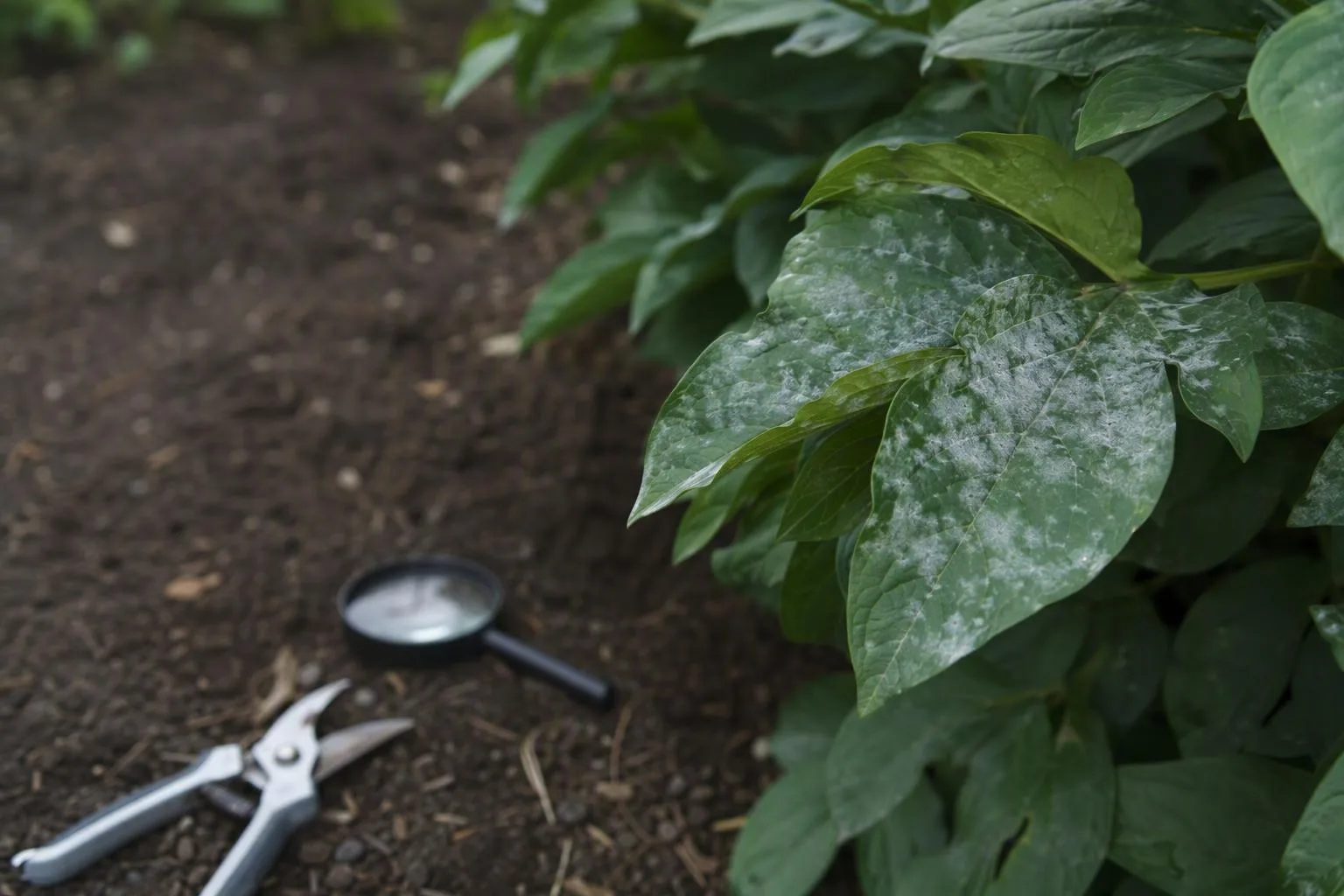
Start with the leaf pattern: confirm powdery mildew before you spray
Begin with the upper surface of several leaves, not just the most conspicuous one. Powdery mildew commonly looks like flour dusted across the leaf: a white to gray, superficial growth that may begin as small patches and merge across the surface. It can also appear on stems, petioles, and flower buds. The tissue beneath may remain green at first, which is one reason the disease is easy to dismiss.
Use a hand lens if you have one. You are looking for a fungal coating sitting on the surface rather than a discoloration embedded in the leaf. Check both sides of the leaf, the newest growth, and the shaded centre of the clump. Record three things: where the growth is located, whether the leaf has angular yellow or brown patches, and whether the material smears, lifts, or behaves like a dried deposit.
That short inspection prevents three common mistakes. Pale leaves can be senescing after a stressful spell. A dried spray or dust deposit can sit on the surface without advancing. Downy mildew usually produces more defined yellow, brown, or angular lesions, with fuzzy growth more often associated with the underside in humid conditions. The two diseases can overlap in a general description, but their visible pattern and management are not interchangeable. The guide How to tell powdery mildew from downy mildew on garden plants is useful if the underside of the leaf tells a different story from the top.
Three close looks that prevent the wrong treatment
| What you see | What to inspect next | Practical reading |
|---|---|---|
| White, flour-like patches on upper leaves or stems | New growth and shaded inner leaves | Powdery mildew is a reasonable working diagnosis |
| Angular yellow-brown areas, often bounded by veins | Leaf undersides during humid weather | Investigate downy mildew or another leaf-spot problem |
| Even film, gritty specks, or material that wipes away cleanly | Recent sprays, dust, insects, and leaf undersides | Residue or pest evidence may be masquerading as disease |
A cotton swab can help with texture, but do not treat the swab test as a laboratory diagnosis. Some mildew lifts; some adheres as the infection develops. If the pattern is spreading quickly, the lesions are unusual, or several plants show different symptoms, photograph both leaf surfaces beside a ruler and ask a local extension service, plant clinic, or knowledgeable nursery for a second opinion.
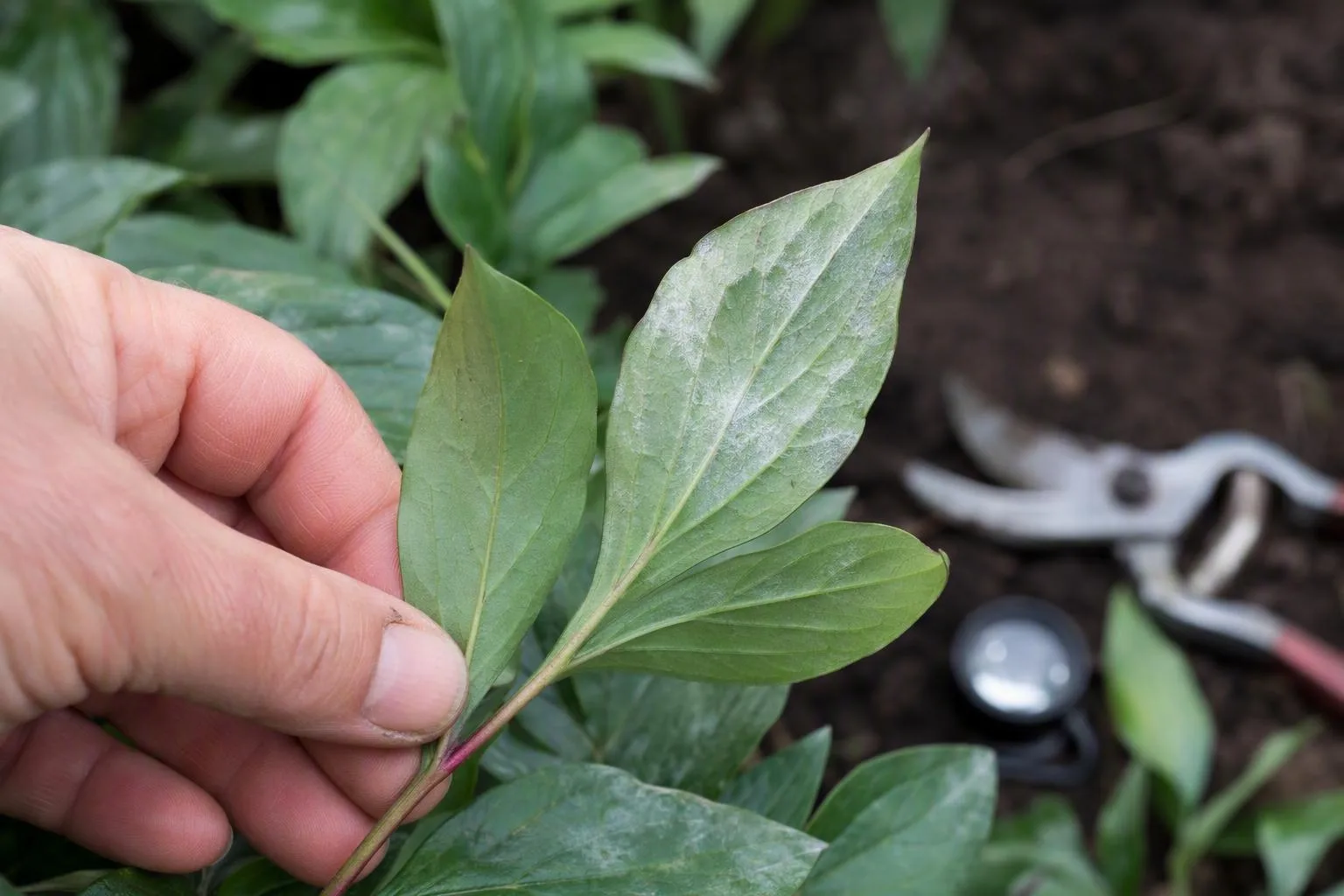
The 14-day response plan: sanitation first, sprays only when they earn their place
A repeatable response is more useful than a dramatic one. The following sequence is designed for an active peony clump in mid-season, when the leaves are still supplying the crown.
- Day 1: remove the worst tissue. Cut leaves that are heavily coated, collapsing, or touching several neighbouring leaves. Bag them rather than dropping them at the plant’s base. Remove fallen infected debris as well. Home compost is suitable only when the pile reaches and maintains pathogen-killing heat throughout the material; a cool heap is not a reliable sanitation step.
- Day 1: open the canopy selectively. Remove a weak, crossing, or badly congested stem if taking it out creates a real air channel. Don’t strip every leaf from the centre. Peonies need their remaining green foliage, and a heavily pruned clump can be left with more exposed, stressed tissue and less capacity to replenish the crown.
- Days 1–14: change the wetting pattern. Apply water to the soil in the morning when irrigation is needed. Avoid routine evening wetting of the leaves, especially where the foliage stays damp into the night. Overhead water is not the sole cause of powdery mildew, because many powdery mildew infections develop without a film of free water, but persistent humidity and poor ventilation make the canopy a better place for disease to continue.
- Days 3, 6, 9, 12, and 14: inspect the new growth. Look at leaves that were clean on day one. Mark one or two shoots with a piece of string if the clump is large. The question is not whether old white leaves have become green; they will not. Ask whether clean leaves are acquiring fresh colonies and whether the affected area is expanding.
- At day 14: decide whether treatment has earned its place. If the disease has stopped after sanitation and canopy changes, continue monitoring. If it is appearing on successive flushes of new leaves, use a product whose label includes powdery mildew and the intended ornamental use. Follow the label for mixing, coverage, repeat interval, protective equipment, re-entry, and disposal.
Here is a concrete way to use the plan. Imagine a mature clump with ten flowering stems and four inner leaves carrying dense white growth. Remove those four leaves plus fallen debris, take out one visibly crossing stem, and leave the other green leaves intact. At the next inspection, new white colonies on previously clean leaves indicate active spread. A clean two-week inspection, by contrast, makes a whole-plant spray harder to justify. This is not a guarantee of control; it is a decision rule that separates a moving infection from a static blemish.
Sanitation has a quiet limitation: it removes inoculum and improves the immediate canopy, but it cannot change a humid site or a susceptible plant. A spray has the opposite limitation. It may protect new tissue while the weather and plant architecture continue to favour infection. Treating without changing the canopy often produces a neat label record and a disappointing plant.
If you use a fungicide, match the product to the timing—not the symptom
Read the product label’s claim carefully. “Controls” may describe prevention, suppression, or disease management rather than restoration of damaged leaves. Horticultural oils, sulfur, potassium bicarbonate products, and conventional ornamental fungicides differ in how they are used, what conditions restrict them, and how much coverage is needed. A product that is suitable for one ornamental crop or disease may not be labelled for peonies.
Oils and sulfur deserve particular caution because foliage injury can occur when the product label’s temperature, application interval, or crop-combination restrictions are ignored. Potassium bicarbonate products can suppress early mildew under some conditions, but a homemade baking-soda mixture is not a dependable cure and may burn leaves if concentration, spreader, water quality, or weather work against it. Use a registered, labelled product if you choose that route rather than converting a kitchen recipe into a garden treatment.
Spray coverage matters most on clean or newly expanding leaves. Avoid spraying open flowers when the label restricts it, and account for pollinators, drift, children, pets, and nearby edible crops. Peonies are ornamental, but residues still have practical consequences: keep treated foliage away from harvested food and obey the stated re-entry and harvest restrictions for any product used near edible plants.
For authoritative label and pesticide-safety guidance, check fungicide label and pesticide-safety guidance from agricultural authorities before mixing anything. The label is the controlling document for that product, not a general mildew recipe copied from another crop.
The weather-and-canopy explanation: why a dry-looking disease thrives in a wet garden
Powdery mildew looks dry because its visible growth sits on the surface. The disease still responds strongly to the air around the leaf. Many powdery mildew fungi germinate and spread without the leaf being covered by liquid water, while humid, still air can support infection. That is why a peony under a sprinkler is not the only peony at risk, and why “keep the leaves dry” is incomplete advice.
A dense clump creates its own weather. Leaves overlap, transpire into a confined space, and dry more slowly than leaves exposed to moving air. Cool nights followed by warm days can leave the inner canopy humid even when the garden surface looks dry by breakfast. Shade adds another constraint: lower light reduces the plant’s opportunity to replace damaged tissue while the crowded architecture keeps the disease environment in place.
Separate controllable causes from background conditions. You can thin a crossing stem, move irrigation to the soil, reduce excessive nitrogen, and choose a more open planting position. You cannot move a humid weather system away from the bed. The most useful intervention is therefore the one that changes several variables at once: an open canopy receives more light, dries more readily, and is easier to inspect.
Nitrogen, senescence, and the misleading end of the season
Fast, soft leafy growth is attractive to a gardener who wants a large peony, but excess nitrogen can create a canopy that outgrows its support and dries poorly. That is a mechanism-based concern, not a reason to starve the plant. A peony still needs balanced nutrition, and a soil test is a better basis for correction than adding a low-nitrogen product simply because mildew appeared.
Late-season yellowing creates a separate trap. As the plant approaches dormancy, older leaves naturally lose colour and contribute less to the crown. A white film over a fading leaf may be mistaken for a crisis, while removing healthy green leaves too early removes the tissue still making and exporting carbohydrates to the crown. The sensible cutback point is after frost has blackened the foliage or after it has naturally died back, not the afternoon a single mildew patch appears.
Repeated severe infections can reduce the plant’s useful green area and may leave a crowded or stressed peony with less reserve. That is why the disease deserves management even though a single light infection on an established plant is rarely an emergency. The target is not a spotless photograph. It is enough healthy foliage to carry the plant into dormancy without allowing the disease to run unchecked.
Build next season around airflow: spacing, watering, cleanup, and cultivar choice
Prevention starts before the first white patch. Put peonies where mature foliage receives morning sun and where air can pass around the clump. Avoid wedging them between a solid hedge and a wall, or burying them in the centre of a dense perennial border. If moving the plant is unrealistic, remove selected neighbouring stems and thin growth around the peony instead. The aim is a channel through the foliage, not an empty bed.
Routine overhead irrigation is a poor default for a peony border. Water the root zone when the soil and weather call for it, preferably early enough for incidental moisture to dry. This reduces prolonged surface wetness and keeps the leaves from being repeatedly battered or splashed with soil. For the wider question, Does overhead watering cause fungal disease in ornamental gardens? provides the useful distinction between water as a direct cause and water as one part of a humid, poorly ventilated canopy.
Use nitrogen with restraint. If a soil test shows adequate fertility, adding more feed to chase pale growth can produce lush stems without solving the underlying problem. Mulch can conserve soil moisture, but keep it pulled back from the crown and avoid building a dense, wet collar around the stems.
Keep the foliage after flowering while it remains green. Deadhead flowers if you want to prevent seed formation or tidy the plant, but postpone the major cutback. The practical calendar below keeps sanitation from stealing the plant’s remaining working leaves:
- Bud break: check that last year’s debris is removed and that new shoots are not boxed in by neighbouring perennials.
- Flowering: inspect the inner leaves when watering or deadheading; early patches are easier to manage than a canopy-wide coating.
- Mid-season: check clean new growth after humid spells, especially where nights are cool and the clump is shaded.
- After flowering: correct irrigation and canopy congestion, but retain healthy green leaves.
- After frost or natural dieback: cut and remove the dead stems and foliage, clean up fallen material, and keep diseased debris out of a cool home compost pile.
Cultivar choice belongs in the risk-reduction column, not the guarantee column. Some peonies and growing situations appear less troubled than others, but susceptibility can vary with weather, planting density, and the particular mildew population. Ask a reputable nursery or botanical garden for cultivars that perform well locally, then give even a reportedly resistant plant adequate air space.
For the cutback timing, see When to cut back peonies after flowering and frost. If the clump is part of an overcrowded border, How to improve airflow in crowded perennial beds without moving every plant gives you more options than lifting every crown.
Common misreads that lead to unnecessary damage
Can powdery mildew kill a peony?
An established, otherwise healthy peony will usually withstand a light infection in one season. Severe, repeated coverage is still worth correcting because it reduces working leaf area and can compound other stresses. Look at the plant’s trajectory: new colonies spreading across clean leaves call for action; a few static marks late in the season call for monitoring and timely cleanup.
Should you cut back the whole plant at the first sign?
No. Remove badly affected tissue where practical, but preserve healthy green foliage until frost or natural dieback. Whole-plant cutting in mid-season trades a cosmetic improvement for the loss of leaves that are still feeding the crown.
Will baking soda cure it?
Bicarbonate products may suppress an early infection in some conditions. They are not a reliable cure, and a homemade mixture can injure foliage. If a bicarbonate product is used, choose one labelled for the intended ornamental application and follow its instructions.
Can the peony mildew spread to vegetables?
Powdery mildew fungi are commonly host-specific or host-limited, so the fungus on a peony is not automatically the same fungus affecting squash or cucumbers. Keep diseased debris out of beds, inspect susceptible vegetables separately, and manage each crop according to its own symptoms and label-approved treatments.
Save the 14-day inspection sequence rather than waiting for the plant to look dramatic. The next decision is straightforward: if clean new peony leaves remain clean, keep the canopy open and monitor; if fresh colonies continue to appear, identify a labelled treatment and apply it to protect the growth the plant still has time to use.
Frequently Asked Questions
Can powdery mildew kill a peony?
Usually not an established, otherwise healthy peony in one season; explain how repeated severe infections can reduce photosynthesis and vigor, especially in crowded or stressed plants.
Should I cut back peonies immediately when I see powdery mildew?
Remove severely affected tissue if practical, but keep healthy green foliage until frost because it continues supplying carbohydrates to the crown; complete seasonal cleanup after the foliage naturally dies or is blackened by frost.
Will baking soda cure powdery mildew on peonies?
Explain that bicarbonate products may suppress early infections under some conditions but are not a reliable cure, homemade mixes can burn foliage, and any product used should be labeled for the intended ornamental use.
Can powdery mildew spread from peonies to vegetables?
Explain that powdery mildew is usually host-specific or host-limited, so the peony fungus is not automatically the same one affecting squash or cucumbers; sanitation and airflow still reduce overall disease pressure.