Powdery Mildew on Roses? 3 Lookalikes and the Right Fix
A rose leaf covered in a white, wipeable film needs a different response from a leaf freckled with yellow dots or marked by angular brown patches. Start by examining the newest leaves and the undersides before you spray: true powdery mildew on roses usually forms an expanding surface colony, while its three common lookalikes leave different evidence. Remove badly coated tissue, keep water off the foliage, open crowded growth, and only then decide whether a labelled fungicide is justified.
That order matters. A fungicide cannot turn an already distorted leaf green again, and pruning a rose hard for a problem that is actually spider-mite damage can leave the plant with less leaf area and no solution.
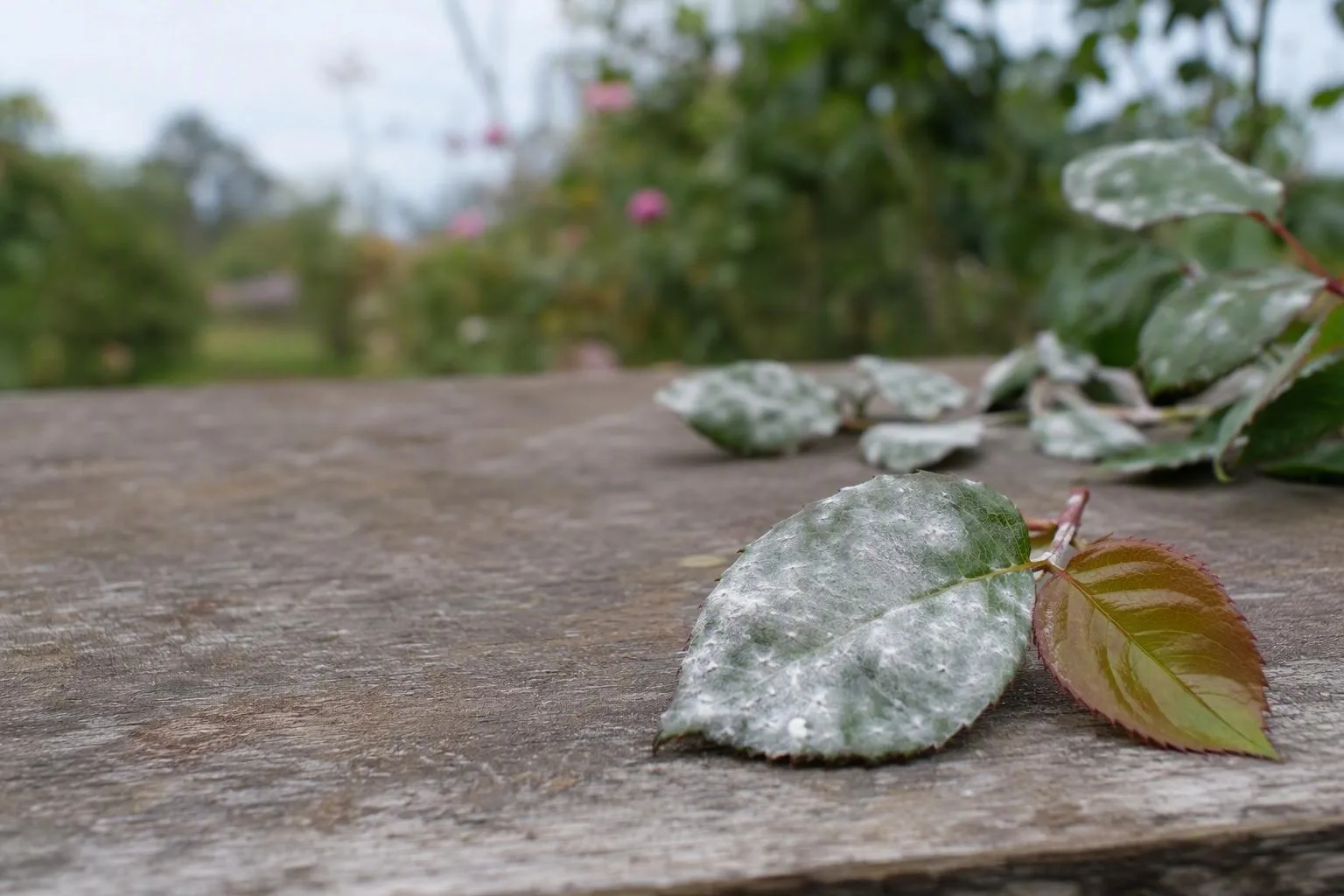
Start with the leaf: the fastest way to separate powdery mildew from its lookalikes
Use a hand lens if you have one, but your fingers are useful too. Choose a fresh-looking leaf near the shoot tip and inspect both surfaces, the petiole, the stem, and any unopened buds. Rub one white mark lightly with a clean fingertip or cotton swab.
- Powdery mildew: the mark is usually a white, powder-like growth on the surface. It may begin as a small colony and spread across the leaf, stem, or bud.
- Spider mites: the leaf is stippled with many tiny pale dots. The surface does not carry a continuous white fungal film; fine webbing may appear around leaf axils or shoot tips.
- Downy mildew: look for yellow, brown, reddish, or purple-tinged lesions with growth more often associated with the underside. The upper lesion usually has a defined shape rather than a soft flour-like coating.
A white deposit that wipes away cleanly and does not return on new growth may be spray residue, hard-water mineral residue, or dust. If the mark is only on the old leaf, does not expand, and leaves no matching growth on nearby tissue, pause before treating it as a pathogen.
Take a phone photograph before removing anything. Include the top and underside of the same leaf. That simple record prevents a common diagnostic mistake: remembering the white coating but forgetting whether the leaf was also stippled, angularly blotched, or distorted.
What genuine rose powdery mildew looks like at three stages
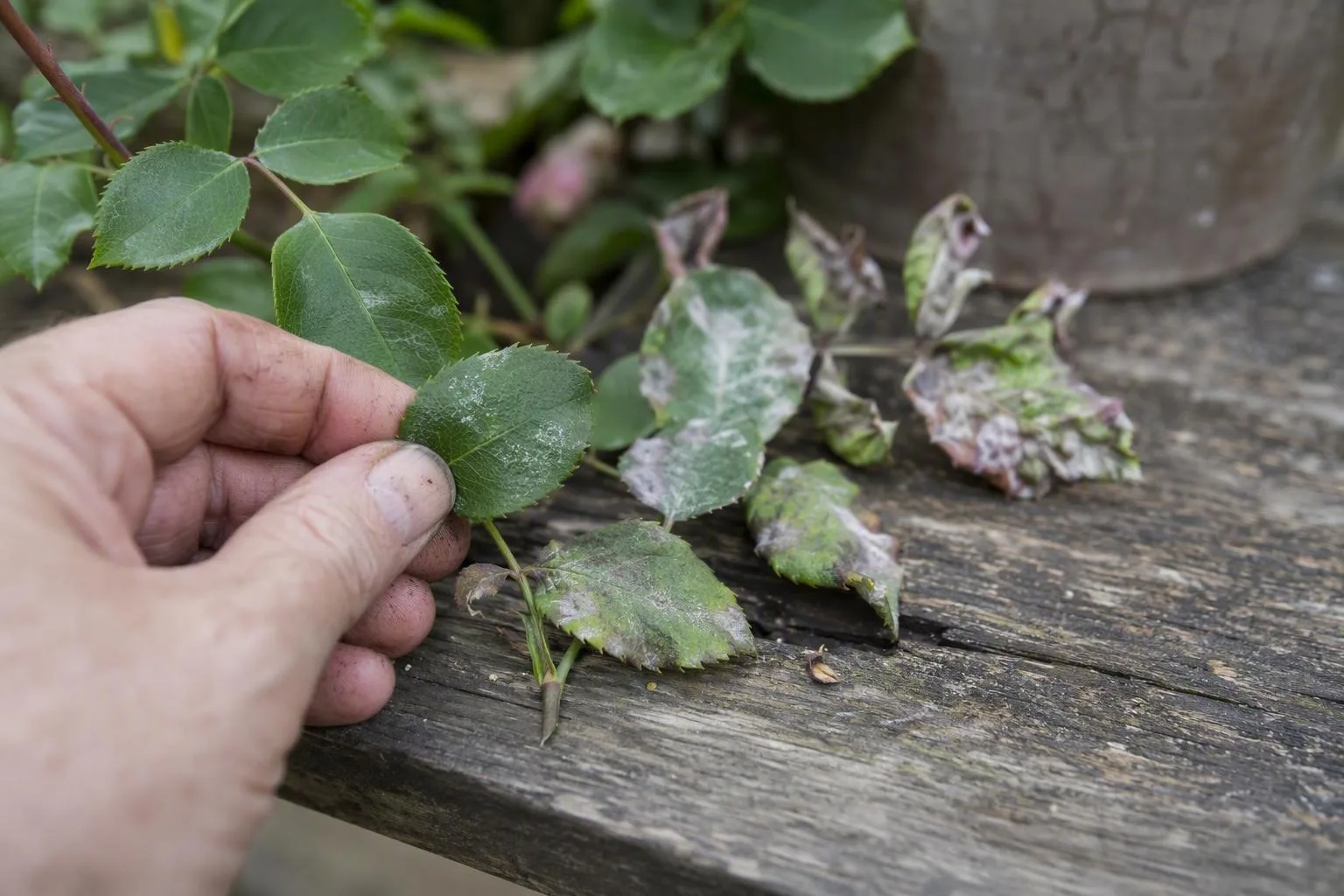
Early powdery mildew is easy to miss because the first colony may be no larger than a fingernail clipping. Look along the youngest leaves and the soft green stem behind a developing bud. The growth often appears as isolated white patches rather than an even dusting over the whole plant.
As colonies enlarge, the leaf can pucker, curl at the margin, or fail to expand flat. New leaves may look narrower or twisted. Affected stems can carry white patches between nodes, and buds may be coated before they open. On a badly affected shoot, the foliage looks grey-white and tired rather than simply dirty.
The final stage is not necessarily a dramatic white plant. Some infected leaves yellow, dry, or drop after their growth has been distorted. That damage can remain visible after the active surface growth has faded, so old symptoms are a poor reason to repeat a spray. Inspect the next flush instead.
The disease can develop when the leaf surface itself is dry. The useful distinction is between surface wetness and humidity: a rose may have dry foliage by midday while still experiencing humid nights and a sheltered, poorly ventilated canopy. That combination can leave the tissue in a favourable window for infection without the long periods of leaf wetness associated with many other leaf diseases.
Do not confuse a temporary white residue with a living colony. A residue stays where the droplet dried. Mildew tends to appear on additional nearby tissue, especially tender growth, and the plant's leaves may become puckered or curled as the colony develops.
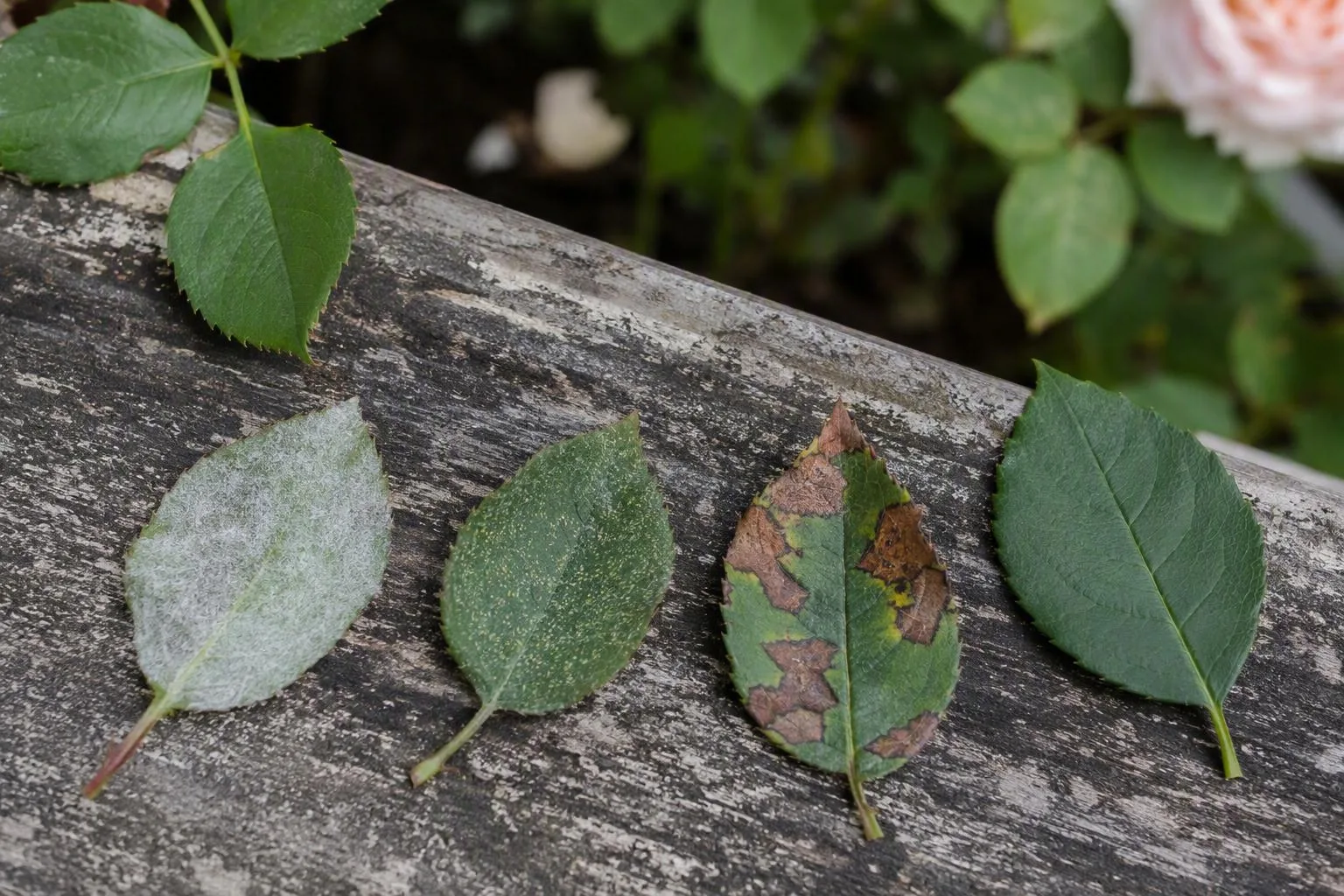
The three impostors: downy mildew, spider mites, and spray injury
In my read of these three lookalikes, downy mildew is the most confusing because both diseases can involve a rose's new foliage and can leave the grower staring at a vague pale patch. The underside and the shape of the upper-surface lesion usually settle the question more reliably than colour alone.
| What you see | Where to look next | First response |
|---|---|---|
| White, flour-like colonies that expand across surfaces | New leaves, stems, petioles, and buds | Remove heavily affected tissue and improve canopy ventilation |
| Fine pale stippling, bronzing, and possible thin webbing | Leaf undersides, axils, and stressed shoot tips | Check for mites and correct root-zone water stress before choosing a product |
| Angular yellow, brown, or purplish lesions with underside growth | Underside of lesions after cool, humid periods | Separate the diagnosis from powdery mildew before spraying |
| Flat white film that stays where a droplet dried | Sprayed surfaces and nearby furniture or paving | Wash or wipe a small area and watch whether fresh colonies form |
Spider-mite damage has a different visual grammar. Instead of a colony sitting on the surface, thousands of feeding punctures drain colour from the leaf in fine, even speckling. Webbing is a useful clue, but its absence does not rule mites out in an early infestation. The related guide on spider mites on roses: stippling, webbing, and the water-stress connection is the better next reference if the leaf looks peppered rather than coated.
Downy mildew deserves its own caution. The upper leaf may show discrete angular lesions bounded by veins, while growth on the underside can be greyish or purplish under suitable conditions. That is not the same presentation as a soft white colony spread across the upper surface. Because the organisms and environmental triggers differ, treating every pale rose lesion as powdery mildew is a poor shortcut.
Spray injury can mimic disease after a new product is applied. Look for a consistent pattern: leaf edges, exposed upper surfaces, or every plant reached by the same spray. New fungal colonies usually follow plant tissue and continue appearing after the original application, whereas residue and chemical scorch remain tied to where the liquid landed. If the product was applied to a drought-stressed rose or during heat, record that before making another application.
The right fix depends on how much of the plant is infected
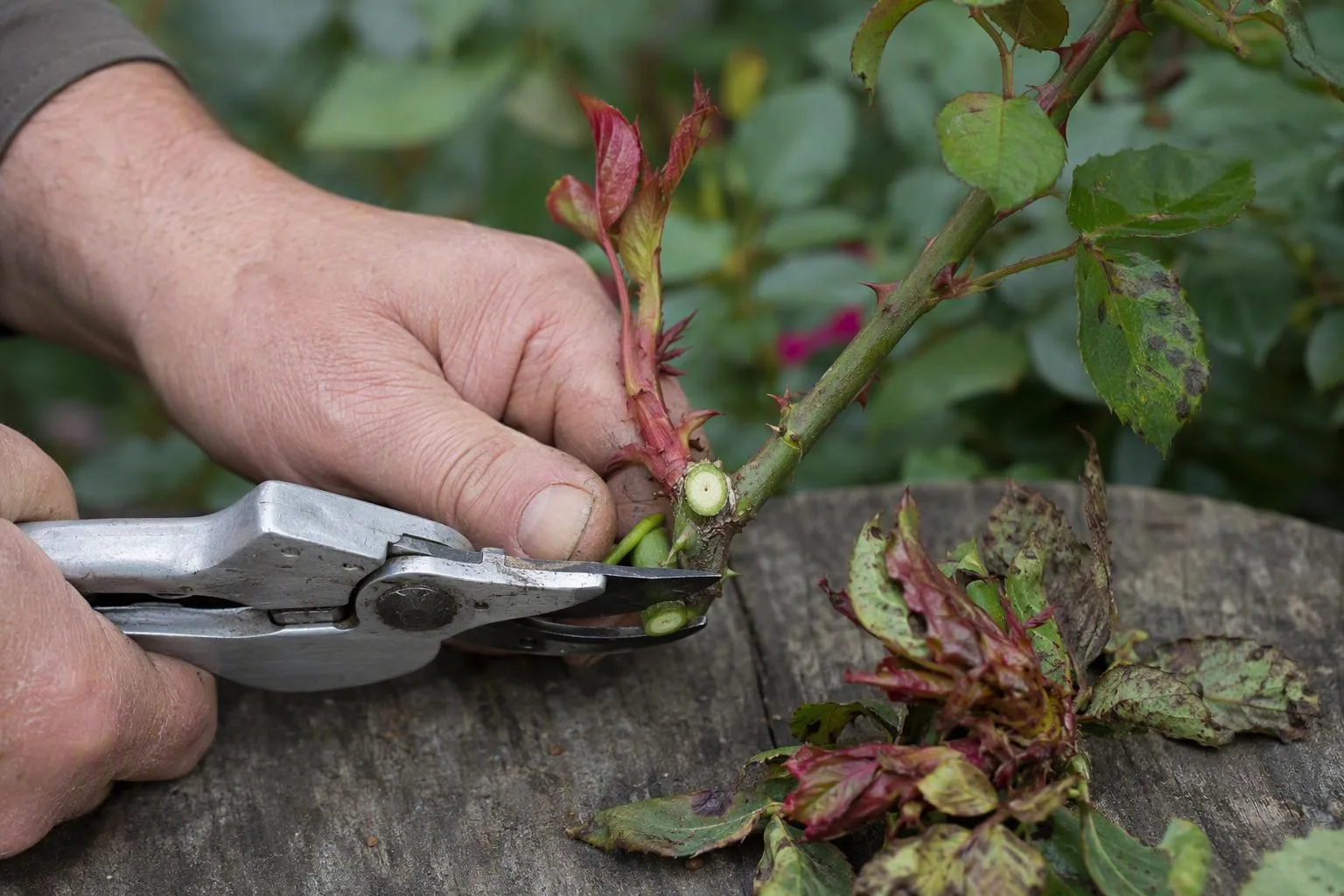
For a light infection, remove leaves with broad coatings and snip out one badly affected shoot if it is crowded or distorted. Put the material in household waste where local rules require it, rather than shaking it through the rose bed. Thin crossing growth so air can move through the centre, and water the soil at the root zone.
Do not strip every leaf from a rose because you found one colony. Leaves are the plant's working solar panels. Removing a small number of damaged leaves can reduce inoculum and improve the canopy; removing most of the canopy adds stress and leaves the plant with less capacity to rebuild roots and new shoots. That is a judgement call, not a race to make the bush look clean.
With established infection, remove the most distorted shoots first. Make each cut back to healthy tissue or a suitable outward-facing bud, then disinfect tools if you move between visibly affected plants. A cut that leaves a short, diseased stub is poor general pruning practice: the stub retains damaged tissue close to the next flush, while a clean cut at healthy tissue removes more of the visibly affected section and avoids leaving a dead-end fragment in the canopy.
Clean fallen leaves from beneath the plant, then inspect the new growth every few days while conditions remain warm and humid. This is more useful than repeatedly judging the old leaves. If fresh colonies keep appearing despite sanitation and a more open canopy, a fungicide labelled for roses may be reasonable. Follow the label for dose, interval, protective equipment, re-entry, edible-plant restrictions, and pollinator precautions; ornamental products are not automatically suitable for food crops.
Expect protection, not erasure. Most fungicides used against powdery mildew work best by protecting uninfected or newly expanding tissue, and some have limited activity against an established colony. Existing white growth and curled leaves may remain ugly until the plant sheds or replaces them.
Why common mildew remedies quietly fail
Baking-soda mixtures, milk sprays, sulfur, and horticultural oils are often discussed as though they are interchangeable. They are not.
A bicarbonate spray may alter the leaf surface enough to make infection less favourable, but a home mixture has no dependable label direction for every rose, water quality, temperature, or cultivar. Excess concentration can scorch foliage. Treat it as an experimental, limited-area option only if local guidance and the product instructions support its use, not as a guaranteed cure.
Milk sprays are similarly conditional. They may help under some conditions, but the result depends on concentration, drying conditions, repeated coverage, and how much active disease is present. If a rose is already covered in colonies, relying on milk alone is a poor trade: the plant needs sanitation and a canopy change first.
Sulfur can be useful in a labelled programme, but heat increases the risk of plant injury, and sulfur should not be applied too close to horticultural oil. The exact interval and temperature limit belong to the product label, which overrides a generic calendar. Oils can also injure drought-stressed or heat-stressed plants. Spray the underside and new growth only when the label permits it, and never assume that more thorough wetting means better control.
Repeated pruning fails for a different reason. If every new shoot emerges into the same stagnant, nitrogen-rich, humid canopy, cutting the previous shoot simply resets the problem. Pruning is a lever; it is not a substitute for changing the conditions around the next flush.
Prevent the second flush: a rose-care plan for the next six weeks
Days 1–3: photograph the symptoms, remove the worst leaves and shoots, clear fallen debris, and check whether the rose is planted tightly against a wall, hedge, or another rose. Avoid overhead irrigation while diagnosing.
Week 1: water slowly at the root zone when the soil needs it, rather than giving frequent shallow splashes. Selectively thin shoots that rub, cross, or form a dense bundle. The aim is not an empty centre; it is fewer leaves pressed together where air cannot move.
Weeks 2–3: inspect the newest leaves and buds twice a week. Look first for fresh white colonies, then for mite stippling and underside lesions. Hold nitrogen-heavy feeding while the plant is producing soft, crowded growth. If symptoms are expanding, choose a labelled rose product based on the confirmed diagnosis rather than alternating household remedies.
Weeks 4–6: keep removing fallen infected material and reassess the site after a new flush. A rose that produces clean leaves after sanitation and improved airflow may need monitoring rather than treatment. A rose that repeatedly develops colonies on every flush is telling you that cultivar choice or site design deserves attention. The guide on how to choose disease-resistant rose cultivars for humid gardens is the useful planning step; resistance is not immunity, but it can reduce how much intervention the site demands.
Watering at the root zone is worth treating as a separate design decision, not just a disease tip. The practical guide to watering roses at the root zone: frequency, depth, and mulch can help you adjust irrigation without keeping the surface constantly wet.
My strong preference is to make the decision from fresh symptoms. Monitor when new growth is clean. Prune when infection is localised and the canopy is crowded. Treat when active colonies continue to expand and the label-approved product fits the plant, weather, and timing. Old damage is evidence of what happened; it is not proof that the same treatment is needed today.
Questions gardeners ask after the diagnosis
Can a rose recover from powdery mildew without fungicide?
Yes, a lightly affected rose may produce clean new growth after infected tissue is removed and the canopy becomes less favourable to the disease. Severe or recurring infection may justify a labelled preventive programme, but the site conditions still need correcting or the problem can return.
Does powdery mildew on roses spread to other plants?
Powdery mildew fungi are often host-specific or host-limited, so a rose infection does not automatically infect every plant nearby. Inspect other susceptible roses and known hosts, remove infected debris, and avoid carrying contaminated plant material around the garden.
Should I cut off every leaf with powdery mildew?
No. Remove heavily coated leaves and badly distorted shoots, but retain sound foliage when the infection is minor. Excessive defoliation can reduce the plant's ability to rebuild roots and support the next flush.
Save the diagnostic sequence: coat, spots, underside, residue; then remove, open, water, and reassess fresh growth. That five-second pause is often the difference between fixing the rose and simply adding another product to the problem.
Frequently Asked Questions
Can a rose recover from powdery mildew without fungicide?
Yes, a lightly affected plant may produce clean new growth after infected leaves are removed and conditions improve, but severe or recurring infections may need a labeled preventive fungicide and better site conditions.
Does powdery mildew on roses spread to other plants?
Powdery mildew fungi are often host-specific or host-limited, so the rose pathogen will not automatically infect every nearby plant; remove infected debris and inspect susceptible roses and other known hosts.
Should I cut off every leaf with powdery mildew?
Remove heavily infected leaves and shoots, but do not strip a rose bare when only a few leaves are affected; excessive defoliation can reduce the plant's ability to rebuild roots and new growth.